Game Design:Theory and Practice (Book's Summary:Part 11)
Book’s Author: Richard Rouse III
Summarized by Samuel Coelho
10. Multi-Player
Though the AI agents take the place of the other players to play a non-computer game, in many ways it is truly the designer who takes the place of the other players.
Multi-player games are as old as game themselves, with single-player games such as solitaire being in the extreme minority of available choices.
10.1 Motivations
Many developers see the most immediate advantage of multi-player games as the ability to replace AI opponents with real humans in order to provide much deeper and more unpredictable adversaries. This increases the amount of challenge a game can provide, and allows a game to stay compelling for a much longer period of time.
An even more significant advantage to having human opponents is the ability for the players to socialize.
The presence of real players for opponents brings with it a tremendous change in the players’ perceived importance of playing the game; instead of just winning or losing the game in private, through their social component multi-player games make each win and loss a public affair and thus significantly more meaningful.
Thus, multi-player games provide for players a challenge, a social experience, the potential for bragging rights, a significant emotional payoff, and a deeply interactive experience. When working on multi-player games, it is important for game designers to keep these strengths in mind and make sure their designs play up these qualities that players are looking for.
However it is important to remember that a multi-player component is not always an improvement for a given game: some titles are ideally suited to being single-player, just as other games can only work as multi-player experiences.
10.2 The Forms
There are two groups of multi-player games, games that are played by a number of gamers all in the same location and huddled around the same computer or console, and games that are played on-line by multiple players who are in significantly different location.
10.2.1 Single System Multi-Player Games
These games originally took the form of multiple players controlling their game-world surrogates in a shared view of the game environment. Games like that are limited in that both players have to be constrained to relatively the same portion of the game-world so that they can both stay visible.
A solution for the problem of constraining two or more players to the same location came with the advent of split-screen gaming, where each player has a section of the monitor devoted to displaying the portion of the game-world that is relevant to them at any given time. The display game could be set to dynamically switch to non-split-screen when both players happen to be in the same location in the game-world.
The split-screen feature is not detrimental to a game such as Mario Kart, but can often weaken the experience in a game like Halo, whose death-match gameplay is modeled after online, blind-play competition. Split-screen simply makes it a different type of game.
Despite the potential disadvantages in terms of blind-play, multi-player games that take place around one system have a tremendous advantage in terms of the social interactions they engender.
10.2.2 On-line Multi-Player Games
Networked games provide a significantly more immersive player experience for the very reason that the other players are invisible to each other.
Having players at separate systems means they will be able to have proper blind-play but will be significantly hindered in their ability to interact with each other while playing the game, no matter what the game designer does to facilitate socialization. All these types of games can be fun in if, from the start, the designer is fully cognizant of the strengths and weakness of the type of multi-player game he is building and designs the game to work optimally within that paradigm.
Massively multi-player persistent games (MMPs) such as Ultima Online, EverQuest, and Dark Age of Camelot have become increasingly popular in recent years, though the MUDs (multi-user dungeons/domains) that inspired them have existed for nearly three decades.
Indeed, playing MMPs can be such a lifestyle choice that many couples will play together, with women tending to enjoy them more than other games. These games are much more open-ended in their design, emphasizing multiple paths to success and allowing players to spend their time how they choose. Players can go on quests, get a job and build up a home, or just spend all their time socializing with the other people they meet there. For it to be successful in the long term, the game must provide an interesting enough game that facilitates socialization in conjunction with other rewards.
The success of Xbox Live has made including a multi-player mode de rigueur in console games, at least where such gameplay makes sense.
10.3 Design Considerations
The pacing of multi-player games needs to be more varied than it is in single-player games, for the simple reason that in a multi-player game, players cannot pause the game, since the other players would need to simultaneously pause as well.
Also, most players want to know how much time they need to play your game, since all but the most hard-core have a variety of things to do with their lives other than playing games.
If possible, you want your game design to allow players to feel that they still have something of a shot at success even when they are losing. Games that allow one player to get extremely far ahead of the other players but still require a long and tedious end-game for that player to complete win will encourage the losing player to drop out, essentially forfeiting.
Positive feedback systems can push the player who is ahead in the competition farther ahead, while negative feedback will keep the competition close. Mario Kart, with its front-mounted guns, has a good implementation of negative feedback that helps keep the races closer and thereby more exciting.
Players sometimes will drop out of your game regardless of how much you try to discourage them. Indeed, due to the somewhat chaotic nature of the internet, some players may get dropped from the game in the middle through no choice of their own. Your game will need to handle these dropouts in an elegant way such that the remaining players can continue playing if at all possible, with the now-missing players having essentially forfeited their slots. You may wish to allow them to reclaim their spots in the game if they reconnect quickly enough, to forgive unavoidable Internet flakiness. If having players drop out in the middle is not handled well by your game, you are almost surely doomed to frustrating the players who want to keep playing.
Allowing players to customize their avatar in the game-world is also key to making players feel that they are actually putting themselves into the game.
If your game design does not allow for a flexible enough space for players to develop unique tactics to counter other players’ moves, all but the newbies will quickly lose interest in your game.
10.3.1 Playing to Strengths
For years, single-player games have been built around the limitations of what an AI could and could not do.
In the section 8 of this summary, “Artificial Intelligence,” it’s talked about how an artificial intelligence can be considered to pass the Turing test if players mistake it for a human. For multi-player games, the goal should be somewhat different: players could never mistake their adversaries for anything but other humans.
An online game with players located miles away from each other and who are most likely real-world strangers will probably never recreate the in-person multi-player experience. Nevertheless, the more successful online games include components that force players to socialize as part of the game mechanics, and thereby make the social interplay in the game that much richer.
Though the potential for players to cooperate should be a key part of almost any multi-player game, getting players to actually do it is another problem entirely. One way to improve the chances that players cooperate with each other is to establish a significant advantage over those who do not work together with others. If the cooperative option is too complex and does not provide significant benefits, chances are that most players will choose to just do it all themselves.
A perilous side effect can arise due to those benefits earned by players working together: more casual players will get crushed by the enemy teams, and thus those players may never live long enough to enjoy most of the things in the game.
10.3.1 Protect Newbies
Newbies are the most vulnerable players, and game designers should do everything possible to protect them long enough until they become familiar with the game’s mechanics and tactics.
As a rule of thumb from game development, there is some fixed percentage of players who love to prey on new players who do not stand a chance against them. Although there never can be a perfect solution for the problem that arises with this statistic, some techniques are used in order to minimize this trouble, some of those include allowing player-killers attack only player-killers and setting up safe and training zones. Dani Bunten Berry also suggested that a mentoring system would be appropriate to deal with this problem. Such a system would reward veteran players for watching over new players.
Minimizing features and simplifying game controls will also help new players a lot. By combining simple controls with a deep range of actions and tactics, most people who want to play the game will be able to, without taking the challenge of tactics generation from the seasoned players.
Finally, if your game design supports something more complex than “I win, everyone else loses” gameplay, the game will be a lot more inviting to new players. Many death-match games show the ranking of players at the end of the match instead of just reporting winner. Therefore, to players, there is less shame if they come in fifth out of eight than if all they know is that they failed to win.
10.3.2 Socialization
One of the primary reasons that players engage in multi-player games is to socialize with other players. This is true both in computer games as well as non-computer games. This explains why MUDs have attracted a larger female fan base than first person shooters, for example. The commonly held wisdom says that women enjoy socializing more than men.
For an online game, the designer will need to go out of his way to facilitate player socialization. The first step is providing an interface with which players can chat among themselves.
Of course, chatting via keyboard is significantly inferior to the expressive potential of actual human speech, with the obvious advantage that players can talk while continuing to play the game.
10.4 Development Issues
The first thing the development team should do when deciding about the initial aspects of a given game, is determine if it will be a single-player game or a multi-player game. If these issues are not handled at the initial phase of the project, the consequences can be really bitter… If the team wants to keep the game supporting the new game style, a lot of code may need to be reworked, and some considerable amount of game mechanics may also demand to be rearranged in order to suit the new traits.
Some games that were initially single-player-only games, and that during the middle of the project, have added a multi-player mode ended up with game mechanics that are significantly different for each of these modes. That’s unfortunate, because usually the players who are experiencing the single-player game, and enjoying it, want to find the same traits, related to the game mechanics, also when playing the game in the multi-player mode.
If the team decides earlier, on what type of game they want to work, and if they settle for a multi-player game, a lot advantage can be taken from this, assuming the networking code is working. These advantages come from the fact that the game mechanics can be tested by a group of people very soon in the development process. And once the game mechanics are a known quantity, appending a fun single-player experience based on these predetermined game mechanics can be much simpler.
In some ways, designing a good multi-player game is all about realizing what players will attempt to do after playing your game for a while and how you can better support that with deep mechanics. The longer you have players playing your game, the more you can balance the play experience.
10.4.1 Playtesting and User Feedback
Anticipating what players will try to do in a single-play game is a hard job and doing that for a multi-player game seems to be impossible. Hence, we can conclude that playtesting can be much more important for multi-player games than it can be for single-player games.
Sometimes, testers can be tempted to not report all the bugs that they may find and exploit them for their own benefit.
When your game is unleashed on the masses, issues will come that you have failed to anticipate. These problems are addressed through the use of patches that may come out shortly after the game is released. In the world of massively multi-player persistent games, the duty of maintaining the game is even more important. The players of these games typically pay a monthly subscription fee, so they expect the game mechanics to be adjusted when necessary, a steady stream of new content, and customer service to fix their problems.
Richard Garriot encourage developers to ship games “feature thin” and then add features to the game that players have shown interest or even demanded.
Adjusting the game after it has shipped implicates that the developers will need to do their best to understand the current state of the game and what players are enjoying about it and what they’re not.
We must be aware when assessing direct feedback from players since the players providing the feedback may not represent the average person playing your game. We also must be cautious when listening to much to the participants of the open beta test because if we spent too much time listening to them, we might as well derail the project.
To gather and evaluate information from players, many companies who launch online games usually hire community managers.
It is a good idea to use player metrics to uncover player exploits. If you find that 90 percent of players are using a particular type of object, that may be a sign that it would good if you could create more of these objects. Nevertheless, if you detect that a relative great amount of players aren’t using a particular object or feature, it would be worth of your time to discover why is this happening. If you detect that a specific feature isn’t as needed as you thought before, then it may be a good idea to cut off the feature from the game.
10.4 A World of Their Own
It’s irrefutable that multi-player games, through their inclusion of multiple intelligent players, offer a combination of emergence, novelty, and unpredictability that no single-player games can provide, regardless of how much artificial intelligence improves. Also, we must remember that multi-player gamers are looking mostly for a fun, social experience, not an immersive journey with a great and deeply narrative.
Monday, June 9, 2008


Friday, June 6, 2008
Game Analysis: Loom (Game Design: Theory and Practice)
Game Design:Theory and Practice (Book's Summary: Part 10)
Book’s Author: Richard Rouse III
Summarized by Samuel Coelho
9. Game Analysis: Loom
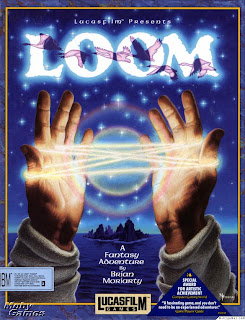 For 1990, the year it was released, Loom was a decidedly different type of adventure game. Loom retains the positive storytelling elements of adventure games and removes everything that conflicted with players’ enjoyment of the story. It succeeded admirably; resulting in a game seemed to earnestly want players to complete its interesting story.
Loom does not challenge players merely for the sake of challenging them, but instead includes only those challenges that are critical to the story.
In Loom the story was king, and whatever stood in its way was removed.
9.1 Focused Game Mechanics
Loom seems to be a perfect example of a game that is completely focused in what it wants to accomplish. Instead of trying to include all of the game mechanics he possibly could, it appears that Moriarty thought long and hard about what were the minimum game mechanics necessary for the telling of his story. He then eliminated everything that did not truly add something to that story. This had the result of greatly simplifying the game, while at the same time making it considerably more elegant and easy to navigate.
Including into Loom an inventory and verbs could have added a lot of depth to the game if the story was reconceived to take advantage of them. But as it stands, the game functions perfectly without them.
9.2 User Interface
Loom keeps its interface as simple as possible by having the player interacting with the game-world by using only the mouse. This, of course, makes the game very easy to learn and play for anyone at all familiar with point-and-click system.
Players could move their character, Bobbin Threadbare, through the world simply by clicking on the location where they wanted him to go.
The single click moves Bobbin towards an object; a double-click has him attempt to use an object.
Copying input ideas from established standards is almost always better than making up something new.
Loom eliminated the verbs entirely to allow users to simple double-click on a given object and then have the game figure out what they wanted to do with the object. If players double-clicked on a person, Bobbin Threadbare would talk to him or her. If it were an object with text on it, Bobbin would read it. If it was a sheep, he would poke it. The game works with players instead of against them, allowing players to perform only the actions that will be useful to them.
One of the primary requirements of any interface is that it be easy to learn. The challenges players face should be in the game-world itself, not in the controls they have to manipulate in order to affect that game-world.
9.3 The Drafts System
Loom introduces a unique and well-designed game mechanic accessible through the main character’s distaff. This system allows players to cast the equivalent of spells on various objects in the world.
The system is based around players hearing different tones in different situations and then repeating those tones on their staff. Players repeat the notes simply by clicking on different locations of the staff, a quite intuitive interface.

If players play the game in the expert setting, the learning of drafts becomes significantly more difficult. The musical notation is no longer present on the screen, and now players only hear notes.
The musical nature of the drafts and of the entire game is a tremendous break from most other games that can be played with the sound completely off. Instead of just using music for sonic wallpaper, Loom beautifully makes the music an integral part of the gameplay.
The order of the tones can be reversed to cause the opposite effect of playing the tones forward.
The objects players double-click on to originally learn the tones all correspond to the drafts they teach players: double-clicking on a blade teaches the “sharpen” draft, double-clicking on water dripping out of a flask teaches the “emptying” draft, double-clicking on a pot full of bubbling dye will teach the “dye” draft, and so forth.
The manipulation of these drafts makes up the primary source of puzzles in the game, and they are used in such a way that the puzzles are never overly convoluted.
9.4 Difficulty
Adventure game enthusiasts who had been hardened on the adventure games that came before Loom found it very easy to finish. They were used to dying around every corner and spending hours bashing their heads against nearly incomprehensible puzzles.
If players were not already experienced with these twisted and convoluted exercises in masochism, there was a good chance an adventure game would frustrate players so much that they would feel no desire to try another one.
9.5 Story
The story Bobbin Threadbare, the chosen “Loom-Child” whose task is to restore the fabric of reality, is one of simple beauty and great poignancy; Bobbin’s adventure begins, with his trips to the various guilds of the land of Loom, drawing to a unique climax complete with a bittersweet ending.
The story is ideally suited to the gameplay that Loom includes, with navigation and the spinning of drafts being players’ only actions. The gameplay and story are so well integrated that the gameplay ends up involving the player in the story far more than if the story were told in a non-interactive format.
The text in the story is kept to a bare minimum, never going into excessive detail about anything, allowing the players’ imaginations to fill in the holes.
Since Bobbin first acquires the staff at the beginning of the game, it makes logical sense that he would not yet be an expert at it. Thus players’ many failed attempts to use the drafts fit perfectly with Bobbin’s character.
 Loom
If the character is too much of a departure from one players could see themselves being, players may become frustrated when that character speaks lines of dialog they would not say themselves or perform other stupid actions. Loom works around this problem by putting Bobbin Threadbare inside a cloak, with player only ever seeing his eyes.
9.6 Loom as an Adventure Game
For all of its strengths, Loom is still and adventure game, and indeed a fairly linear one.
In Loom, there’s a good chance that, if an object can be manipulated, players will need to do something with it to complete the game. This is both good and bad: good in it limits players’ actions to useful ones instead of leading them down a false path after red herrings and pointless diversions; bad in that it severely limits the interactiveness of the world. And sometimes the game’s landscape art is drawn in such a way that it is difficult to figure out where Bobbin can navigate and where he cannot.
But, truly, these are minor complaints. Is it so bad that Loom is a storytelling experience with a predetermined story? The game is only as worthwhile to play again, as it is to read a book or see a movie a second time.
Book’s Author: Richard Rouse III
Summarized by Samuel Coelho
9. Game Analysis: Loom
 For 1990, the year it was released, Loom was a decidedly different type of adventure game. Loom retains the positive storytelling elements of adventure games and removes everything that conflicted with players’ enjoyment of the story. It succeeded admirably; resulting in a game seemed to earnestly want players to complete its interesting story.
Loom does not challenge players merely for the sake of challenging them, but instead includes only those challenges that are critical to the story.
In Loom the story was king, and whatever stood in its way was removed.
9.1 Focused Game Mechanics
Loom seems to be a perfect example of a game that is completely focused in what it wants to accomplish. Instead of trying to include all of the game mechanics he possibly could, it appears that Moriarty thought long and hard about what were the minimum game mechanics necessary for the telling of his story. He then eliminated everything that did not truly add something to that story. This had the result of greatly simplifying the game, while at the same time making it considerably more elegant and easy to navigate.
Including into Loom an inventory and verbs could have added a lot of depth to the game if the story was reconceived to take advantage of them. But as it stands, the game functions perfectly without them.
9.2 User Interface
Loom keeps its interface as simple as possible by having the player interacting with the game-world by using only the mouse. This, of course, makes the game very easy to learn and play for anyone at all familiar with point-and-click system.
Players could move their character, Bobbin Threadbare, through the world simply by clicking on the location where they wanted him to go.
The single click moves Bobbin towards an object; a double-click has him attempt to use an object.
Copying input ideas from established standards is almost always better than making up something new.
Loom eliminated the verbs entirely to allow users to simple double-click on a given object and then have the game figure out what they wanted to do with the object. If players double-clicked on a person, Bobbin Threadbare would talk to him or her. If it were an object with text on it, Bobbin would read it. If it was a sheep, he would poke it. The game works with players instead of against them, allowing players to perform only the actions that will be useful to them.
One of the primary requirements of any interface is that it be easy to learn. The challenges players face should be in the game-world itself, not in the controls they have to manipulate in order to affect that game-world.
9.3 The Drafts System
Loom introduces a unique and well-designed game mechanic accessible through the main character’s distaff. This system allows players to cast the equivalent of spells on various objects in the world.
The system is based around players hearing different tones in different situations and then repeating those tones on their staff. Players repeat the notes simply by clicking on different locations of the staff, a quite intuitive interface.

Loom
If players play the game in the expert setting, the learning of drafts becomes significantly more difficult. The musical notation is no longer present on the screen, and now players only hear notes.
The musical nature of the drafts and of the entire game is a tremendous break from most other games that can be played with the sound completely off. Instead of just using music for sonic wallpaper, Loom beautifully makes the music an integral part of the gameplay.
The order of the tones can be reversed to cause the opposite effect of playing the tones forward.
The objects players double-click on to originally learn the tones all correspond to the drafts they teach players: double-clicking on a blade teaches the “sharpen” draft, double-clicking on water dripping out of a flask teaches the “emptying” draft, double-clicking on a pot full of bubbling dye will teach the “dye” draft, and so forth.
The manipulation of these drafts makes up the primary source of puzzles in the game, and they are used in such a way that the puzzles are never overly convoluted.
9.4 Difficulty
Adventure game enthusiasts who had been hardened on the adventure games that came before Loom found it very easy to finish. They were used to dying around every corner and spending hours bashing their heads against nearly incomprehensible puzzles.
If players were not already experienced with these twisted and convoluted exercises in masochism, there was a good chance an adventure game would frustrate players so much that they would feel no desire to try another one.
9.5 Story
The story Bobbin Threadbare, the chosen “Loom-Child” whose task is to restore the fabric of reality, is one of simple beauty and great poignancy; Bobbin’s adventure begins, with his trips to the various guilds of the land of Loom, drawing to a unique climax complete with a bittersweet ending.
The story is ideally suited to the gameplay that Loom includes, with navigation and the spinning of drafts being players’ only actions. The gameplay and story are so well integrated that the gameplay ends up involving the player in the story far more than if the story were told in a non-interactive format.
The text in the story is kept to a bare minimum, never going into excessive detail about anything, allowing the players’ imaginations to fill in the holes.
Since Bobbin first acquires the staff at the beginning of the game, it makes logical sense that he would not yet be an expert at it. Thus players’ many failed attempts to use the drafts fit perfectly with Bobbin’s character.
 Loom
If the character is too much of a departure from one players could see themselves being, players may become frustrated when that character speaks lines of dialog they would not say themselves or perform other stupid actions. Loom works around this problem by putting Bobbin Threadbare inside a cloak, with player only ever seeing his eyes.
9.6 Loom as an Adventure Game
For all of its strengths, Loom is still and adventure game, and indeed a fairly linear one.
In Loom, there’s a good chance that, if an object can be manipulated, players will need to do something with it to complete the game. This is both good and bad: good in it limits players’ actions to useful ones instead of leading them down a false path after red herrings and pointless diversions; bad in that it severely limits the interactiveness of the world. And sometimes the game’s landscape art is drawn in such a way that it is difficult to figure out where Bobbin can navigate and where he cannot.
But, truly, these are minor complaints. Is it so bad that Loom is a storytelling experience with a predetermined story? The game is only as worthwhile to play again, as it is to read a book or see a movie a second time.
Thursday, June 5, 2008
Storytelling (Game Design: Theory and Practice)
Game Design: Theory and Practice (Book's Summary: Part 9)
Book’s Author: Richard Rouse III
Summarized by Samuel Coelho
8. Storytelling
Games certainly do not need stories, but it seems that when employed properly, stories can make games much stronger. Games such as A Mind Forever Voyaging, Myst, Ico, and Ultima series, have made the story such an integral part of the game that one can hardly imagine them otherwise.
8.1 Designer’s Story Versus Player’s Story
The designer’s story can be seen in the game through full-motion videos. Its main purpose is to add meaning and relevance to the actions the player performs in the game.
Each level makes-up a mini-story of how players won or lost that level. This is the player’s story.
The player’s story is the most important one to be found in the game, since it is the story the player will be most involved with. This is the story players will most likely share with their friends when they talk about the game.

God of War II
The ideal interactive storytelling is to merge the designer’s story and the player’s story into one, so that players can have a real impact on a story while the story retains its dramatic qualities. The overall story arc doesn’t necessarily need to change, but the player must have a real role in determining what exactly happens in the story.
 ICO
A good example of a truly interactive storytelling experience can be found in many pen-and-paper role-playing games, such as Dungeons & Dragons. In it, the good Dungeon Master will be able to keep players on track with the overall story she wants to tell. While allowing the players a considerable amount of freedom in how that story unfolds and perhaps even in how it resolves
The best a game designer can do currently is try to recreate such an interactive storytelling experience, but, in lieu of dynamically generating the story, anticipate most of the questions players might ask, places they might go, and lines of dialog they might want to say.
8.2 Places for Storytelling
The type of story you hope to tell, what technology you will be using, and the gameplay of your game will determine what storytelling will work best for your project.
Storytelling takes place out-of-game, in-game, and by the use of external materials.
8.2.1 Out-of-Game Storytelling
Very often like a film and uses established cinematic techniques similar to storytelling in other media.
Non-interactive storytelling may have its place in games, but designers need to be aware that it must supplement and not detract from an exciting gaming experience. Most players want to be playing instead of sitting through long cinematics.
We can use cut-scenes, text, images, and audio to tell a story.
One of the most important goals to have when working with cut-scenes is to establish a consistent visual appearance between the game cut-scenes and the gameplay. If at all possible, the same engine should be used for the cut-scenes as for the rest of the game. Use cut-scenes that looks nothing like the game-world only exacerbates matters.
The prevalence of only-skippable scenes leads to a distressing confusion among users from game to game, as they wonder, “If I hit the Start button, will it pause the scene or skip it?” It seems that the out-of-game sections of computer games are less user-friendly than almost any other solo experience medium.
Forcing players to watch cut-scenes is a totally unnecessary limitation no game should attempt to enforce. The players must be able to decide if he wants to see the cut-scene or not.
8.2.2 In-Game Storytelling
There are numerous powerful techniques for telling a story during gameplay. Most of them involves text, level settings, dialog with NPCs during gameplay, and NPC behaviors.
A lot can be communicated to players through text placed around the game-world. There can be signs explaining directions to locations, pinned-up notes left by previous inhabitants of a given area, graffiti on the wall, or books left lying around for players to read.
Setting can be key to telling more complex game stories. The player’s exploration of the game-world can lead to discoveries about the type of people that inhabit a given area, or inhabited it in years past.

The Suffering: ties that bind
The NPCs should not just talk to the player; they should perform actions that back up the story line.
One of the big concerns some people have with in-game storytelling is that players may miss some of the story. But we need to remember that games are an interactive form, and the fact that players do not experience every last element of the story is part of the nature of the interactivity. If players are interested in getting the entire story, it is their responsibility to seek it out. If players would prefer to just charge through the game focusing solely on the gameplay, that is their choice to make. Indeed, having different layers of the story that can be discovered on playing the game a second time can be a significant incentive for replaying the game.
In addition to maintaining the players’ immersion in the game-world, in-game storytelling makes the players active participants in the game’s story instead of just flashing it in front of their eyes.
8.2.3 External Materials
Some games have used external materials extremely effectively. In particular, the Infocom games always included materials in the boxes that added to the player’s gameplay experience in meaningful ways.
We are certainly no longer presented with the technological limitations that necessitated storytelling through external materials. Furthermore, often the stories told in the manuals were not written by the game’s designers or even with their consultation.
8.3 Linear Writing Pitfalls
In a way, the mistakes game developers make putting story into their games are forgivable due to the youth of the medium. For example, when technology that enabled filmmaking was introduced, many of the first films that were made were documents of stage plays. A camera was placed in a fixed position on a tripod and the actors considered its frame to be their stage, just as if they were working with a live audience. There were no cuts, pans, or camera movement of any kind, because the language of film had yet to be invented. As time went on, however, filmmakers learned that their films could be more than straight transcriptions of stage plays, and they could instead take advantage of the strengths of their new medium. In some ways, games still suffer from the same problem, where established mediums, film particular, are taken and just thrown into games without considering how a story might be best told in a language suited to interactivity.
Until technology advances to the point where games are able to simulate conversations significantly better than they do currently, game stories need to center around actions that games do well.
Games are about letting the player letting players find their own path through the game-world, even if the story suffers a little as a result. It’s the player’s story instead of the designer’s story.
8.3.1 Player Character Personality
When players want to play games, often they want to play themselves. If the character they are controlling has a very strong personality, there is a distancing effect, reminding players that the game is largely predetermined and making them feel like they are not truly in control of what happens in the game. Of course that there are games that became quite popular while having extremely well-defined main characters. In these games, players feel more like they are playing the game to unlock a predetermined story, and that they are just uncovering them by playing the game.
You can tell a rich conventional story if you have the player control a very distinct character, but you can suck the player into the game much more if you keep the main character iconic and allow players to feel like they are in charge of determining that character’s personality and fate.
Instead of trying to imbue the main character with a lot of personality, make the NPCs players encounter in the game memorable and interesting.
8.4 Game Stories
The game’s scriptwriter should worry less about the overall plot and more about the situation in which players find themselves and characters with which they interact.
8.4.1 Non-Linearity
In a way, in-game storytelling is non-linear. In-game storytelling allows players to talk to some characters and not to others, to choose which signs to read and which to ignore, and to explore the game-world in order to reveal its relevance to the story line, exploration over which players have control.

Indigo Prophecy
One popular way to add non-linearity to the storytelling experience is through a branching story. With a branching story, at various points the decisions players make will have a significant effect on how the story progresses. Of course branching stories increase the amount of content that will need to be created for a game, at least in terms of game design and dialog, if not also in art assets.
Another technique that can be used to inject some non-linearity into the game’s story is to allow players to determine the order in which different story components occur.
Though the first and final chapters of the game should happen at the beginning and end of the game respectively, the other chapters in the game can happen in any order. Therefore, the writer must keep those plots discrete so that they can be experienced in any order and still make sense. This may have the side-effect that you cannot have each of these interchangeable story chapters build on each other in the same way as you could in a completely linear story.
8.4.2 Working with the Gameplay
One of the most important parts of creating a story for a computer game is to match the story with the gameplay as much as possible.
Your job as a game designer is to find a story and a telling of that story that will work with the gameplay and technology that you will be using.
8.5 The Dream
One could say that the goal of gameplay is to allow for different player strategies to lead to variable types of success, to reward players experimentation and exploration, and to empower players to make their own choices. All of these factors allow players to craft their unique stories when playing your game.
Players should feel ownership over the actions in their game, and thereby ownership in the story that is being told.
Subscribe to:
Posts (Atom)

